Moody Centre: Modest growth in a shrinking City

Claim: Moody Centre experienced the most population growth in Port Moody during the last census period.

Verdict: True. Port Moody lost population overall between 2016-2021, but Moody Centre gained 572 residents.

Whatever his reasons for doing so, Steve Milani likes to point out that Moody Centre is the fastest growing part of the city. Thanks to the handy CensusMapper tool from Mountain Math, we can visualize 2016-2021 population growth (or decline) by census tract.

Green represents growth, and yellow through red represents population loss. It’s then easy to see: not only is Moody Centre the fastest growing part of the city, it’s the only growing part of Port Moody – which managed to lose 16 residents between 2016 and 2021, even as Metro Vancouver added 180,000 residents.

Only in Port Moody: an area with 2.2% annual growth looks remarkable

Moody Centre welcomed 572 residents, or 114 pear year (2.2% annual growth). That’s roughly the equivalent of one 50-unit lowrise per year. The rest of the city was either stable or in decline:

  • Noons Creek managed to lose 194 residents.
  • Heritage Woods/Mountain dropped 147.
  • College Park lost 207 residents, probably related to the Woodland Park redevelopment.
  • The oddly-shaped census tract encompassing Glenayre, Easthill, and part of Moody Centre gained 77 residents.
  • Suter Brook / Klahanie lost 62 residents.
  • The North Shore was stable, slipping by just 25 residents.

To further contextualize Moody Centre’s population dynamics, using Census Mapper we can check 2016-2021 population growth rates near other suburban SkyTrain stations north of the Fraser:

  • 9% and 4.5% annual growth in Coquitlam’s two Burquitlam/Lougheed census tracts.
  • 14.5% and 6.8% annual growth in the two Brentwood census tracts.
  • 6.2% annual in Edmonds.
  • 8.8% and 5.4% annual increase in the two Metrotown census tracts.
  • Rates between 4.2% and 6.8% in downtown New West.

Since completion of the Evergreen Line, growth in Moody Centre has been a tiny fraction of what even more established transit hubs experienced. So much for hyperbolic rhetoric of massive development. And this is after 2011-2016 when almost nothing got built.

It remains to be seen whether the next council will maintain the Moody Centre status quo of approving a few 6-storey lowrises per year – which led to an admonishment by the NDP provincial government for wasting valuable transit infrastructure – or move towards legalizing a greater variety of development types that one would expect around a transit hub.

Haven Lurbiecki caught in major housing fib

Claim: The City of Port Moody’s Housing Needs Report “confirms that Port Moody doesn’t need more market high rises”.

Verdict: Whopper. The report directly calls for more market strata housing so moderate-income households can afford to own their home.

As the Lower Mainland’s housing problems become more obvious, candidates who want to cut home approvals are increasingly trying to frame their position as the result of objective analysis – as opposed to old-school personal preference or ideology.

Of course, following the evidence is a good thing. If that’s what you’re actually doing. Unfortunately, Haven Lurbiecki is guilty of pushing a serious whopper here.

As part of the NDP government’s efforts to get a handle on the housing shortage facing most communities, Minister Selina Robinson introduced a requirement for each municipality to commission a Housing Needs Assessment (HNA) about the amount and types of homes that may be lacking.

Port Moody completed its HNA in September 2021. Here’s Haven’s takeaway from the report:


Unfortunately for Lurbiecki, the report’s conclusion said the exact opposite:

It’s not rocket science. To buy a single family home in Port Moody, you need inherited wealth. Condominiums are the only type of home attainable to young families and working professionals without a major inter-generational wealth transfer.

Other findings from the report reinforce the need for greater homeownership opportunities:

  • Port Moody requires approx. 2,975 additional homes between 2016 and 2026 to meet community demand. Only 1,800 starts have been made so far. (p. 36)
  • “There is a dedicated community of developers willing to build housing for Port Moody residents”, but policy uncertainty about allowable density, height, and approval timelines prevent the necessary housing starts – even in areas designated by the OCP for more housing. (p.37)
  • Both families and single-person households face a severe housing shortage in Port Moody, and should be considered priority groups. (p. 44)

Lurbiecki and allies put great rhetorical emphasis on attacking strata apartments as elite luxuries. Again, that’s a claim contradicted by many data points. Here are just a few in the report:

  • Single-family homes in Port Moody are 239% more expensive than apartments.  (p. 77)
  • 56% of Port Moody households consist of 1 or 2 people (p.63), but 1-bedroom apartments are only 10% of the housing stock. (P. 15)
  • 97.5% of Port Moody households live in market housing. (p. 64)
  • The biggest housing concerns of Port Moody residents are “Cost of Ownership” (68%) and “Lack of Housing Types/Options (64%). (p. 94)

A large majority of Port Moody residents are telling us they’re upset by the high cost of homeownership, and that there are too few homes of all kinds – every data point confirms this. It’s a bold strategy to campaign on putting homeownership even further out of reach.

Steve Milani and the Phantom Red Seal

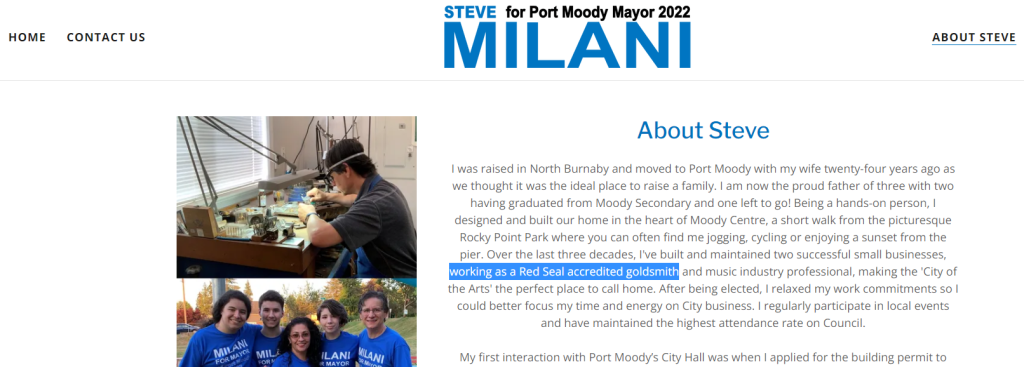
Claim: Prior to entering politics in 2018, Steve Milani worked as a Red Seal accredited goldsmith.

Verdict: Unclear how that would be possible. Red Seal accreditation is not available for goldsmithery or related crafts.

While most of this blog’s focus will be on what candidates are saying about the issues, they also talk a lot about themselves. Pitching an appealing personal narrative to voters can go a long way in civic politics when there’s no party label to vote for.

In highlighting his career prior to getting elected in 2018, Steve Milani has taken to calling himself a “Red Seal accredited goldsmith”. One problem: to our knowledge there is no Red Seal certification available for goldsmithery, nor jewelry craft more broadly.

The phantom Red Seal

“Red Seal” of course refers to a certification earned by a tradesperson upon passing an exam certifying their knowledge meets the interprovincial standard of their trade. Via the BC Industry Training Authority, Red Seal certifications are available for 49 trades. None of them are plausibly close enough to goldmithery or jewelry crafting.

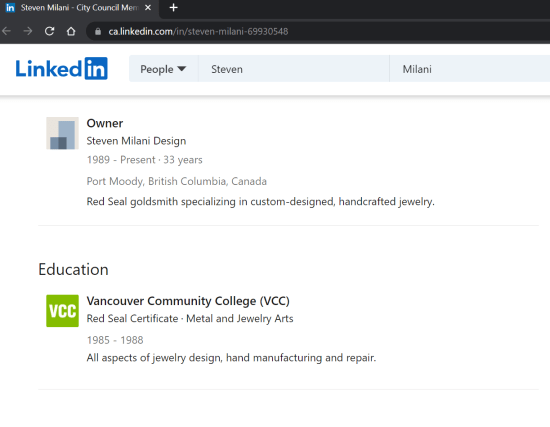
This isn’t some typo from an over-zealous volunteer – Milani repeats the Red Seal claim twice on his LinkedIn page:

Searching through LinkedIn and Google, we can’t find anybody else who claims to have received a Red Seal in goldsmithery or jewelry arts. Just Milani.

If a politician is asking for the votes of professionals who sacrificed years of their life to earn credentials the right way, they should probably have some respect and refrain from inventing certifications which only exist in their biography. One wonders if the BC ITA takes kindly to the Red Seal program reputation being used this way.

Returning to Fact-Based Debate


Port Moody is home to one of the most educated and engaged populations in BC. We deserve politicians that respect our intelligence.

As the October 15 civic election approaches, so thickens the odious cloud of mendacity over the eastern shore of the Inlet; this blog represents a modest effort to re-centre our civic discourse on factual moorings. It will aim to provide factual clarity as a counterpoint to the most egregious whoppers and fudges being circulated by those seeking to wield power over us for the next 4 years.

We welcome submissions and respectful comments.